Make Your Own Sweetpotato "Bonsai"
 |
Sweetpotato is good not only for eating, but can also be grown as a beautiful
house plant. Follow the instructions below from Mr. Mitsuoki Sato, retired
vegetable specialist from the Saitama Prefecture Agricultural Experiment
Station.
Sato says his "bonsai," Japanese for "miniature plantings,"
resemble a forested mountain scene. Don't expect any flowers from your planting.
This technique is designed with the temperate zone in mind, but try it even
further north, especially during long spring and summer days. |
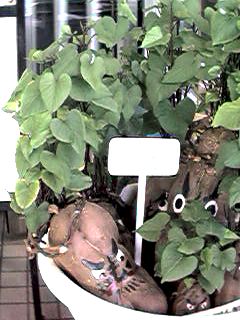
| The photo shows several sweetpotato "bonsai" on display in a pot
at the entrance of Kawagoe City Hall. Faces have been painted onto the tubers. |
|
|
|
|
Sweetpotato "Bonsai" Preparation and Growing
Choose a sweetpotato weighing at least 500 grams (more than one pound).
It should be as free of scratches and other damage as possible. These factors
will help insure healthy growth.
The best shaped sweetpotato for making a healthy "bonsai" should
be not elongated, but as roundish as possible. Beyond that, the actual tuber
shape and color depends on the artistic judgement of the grower.
Plant upright or at a slant in a pot filled with crushed, sterile vermiculite
with the sweetpotato submerged no more than 1/3 in the vermiculite. The
end of the sweetpotato that was attached to the plant should be up since
it will yield the most sprouts.
The bonsai is intended to be a house plant, but place it so as to receive
maximum sun.
The amount of water given the "bonsai" greatly affects its
growth. Standard watering procedure is to soak the vermiculite well once
a week. Less water will tend to stunt sprout growth; more water will yield
lusher growth.
As the sprouts elongate, clip them back to within the second or third
joint from the sweetpotato. Likewise with the branch sprouts, also trim
them to within the second or third joint from the base of the sprout. Excess,
weak, or withering sprouts can be removed as one sees fit. With proper trimming,
the sprouts will stand upright without external support.
Keep an eye out for the appearance of aphids or mites.
If the "bonsai" pot temperature can be kept at least 15 degrees
C (60 degrees F), it will provide beauty year round.
Enjoy! Experiment freely. Please let me know if you develop a better
technique than given above.
Return to Sweetpotato in Japan homepage.